Mommy Makeovers: a Growing Trend
December 26th, 2013
Women are postponing motherhood, waiting longer to have children today. What is the best age to have a baby? Many factors enter into this equation. From a purely biological viewpoint, the late teens or early twenties are best biologically, according to John Mirowsky, a sociologist at the University of Texas at Austin. Women in their twenties are least likely to have developed health problems that would put them or their babies at risk, and they have the lowest rates of miscarriage, ectopic pregnancy, stillbirth, and infertility. Physically speaking, it is apparent that younger women are able to weather pregnancy and bounce back more quickly than older moms.
Perhaps the growing trend of considering a Mommy Makeover reflects the desire to erase the physical toll that later childbearing sometimes brings. Many will agree that having children at any age is one of the most rewarding experiences a mother will have. However, the physical effects of pregnancy, especially multiple pregnancies, can leave unwanted and unflattering changes to your body. Common complaints from my patients include, loss of breast fullness and/or sagging, excess abdominal skin, stretched or torn abdominal muscles and umbilical hernia. Even if you adhere to the 25-35 pound weight gain during pregnancy, it’s often more difficult to get back into shape the older you are when you have a baby. No amount of exercise or weight loss can fix some of these problems. Fortunately, cosmetic surgery is an option to help a patient return to a pre-pregnancy appearance and restore the natural feminine shape following their pregnancy. Some of my happiest patients are women of all age-ranges who have chosen Mommy Makeovers.
Be sure to watch KSTP-TV’s Twin Cities Live, when we share a personal story of a Mommy Makeover.
Mommy Makeover: Breast Restoration
December 18th, 2013
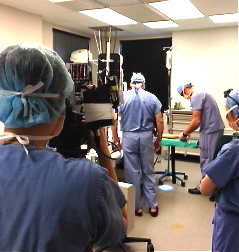
Filming continues in our office this week for another upcoming Mommy Makeover segment for Twin Cities Live on KSTP TV. We are following a patient having breast restoration surgery.
Most of the women that come to me for consultations about breast surgery following pregnancy complain that their breast size or shape has changed. Physical changes may occur to the breasts after pregnancy even in the absence of breast-feeding. Breast restoration surgery addresses these changes.
Patients often report that there is reduced fullness on the top of their breasts, just above the nipple, along with a general change in breast size. The decreased fullness may be interpreted as sagging or a loss of “perkiness.” The most common concern that I hear is the complaint of overall diminished breast size after pregnancy. Women sometimes choose breast restoration surgery as part of a Mommy Makeover, which may also include a tummy tuck.
Augmentation mammoplasty or breast enlargement surgery is the primary procedure that is used to restore breasts to the size they were before pregnancy. According to the The American Society for Aesthetic Plastic Surgery (ASAPS), about 312,000 breast enlargement surgeries were performed last year, making it the number one requested cosmetic surgery. However, there are no specific statistics on how many women chose breast surgery as part of a “Mommy Makeover.â€
Stay tuned to follow our patient’s recovery, when we reveal the final result on TCL scheduled later this winter. Date and time to follow.
Follow Us!